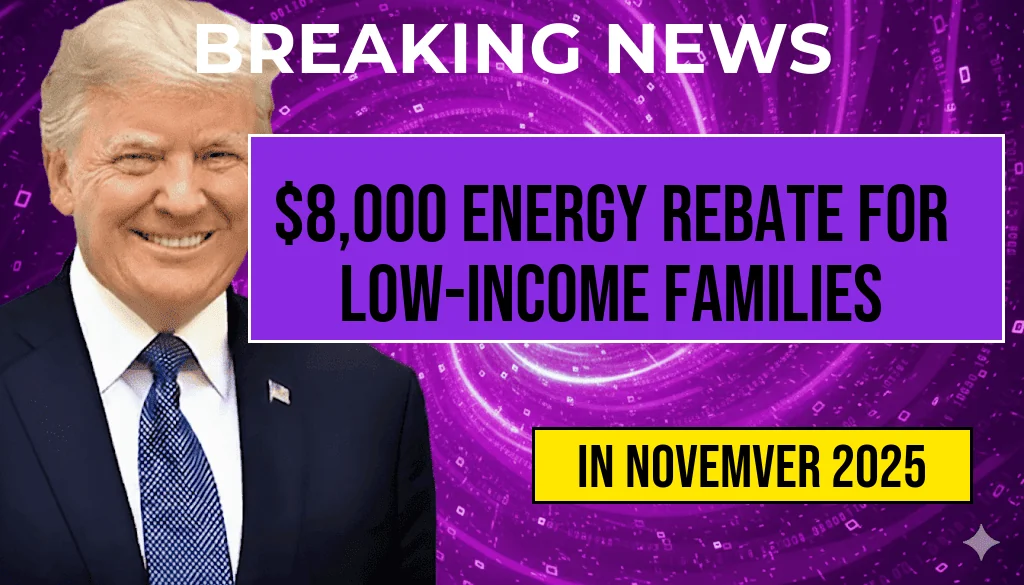
Are You a Low-Income Family Struggling with Rising Energy Costs?
Many families across the USA are grappling with escalating energy bills, leaving them to choose between essential needs like groceries and heating. Starting in 2026, the federal government aims to ease this burden with a new initiative: an $8,000 annual energy rebate for low-income families. This program is designed to provide relief and potentially alleviate the financial stress that comes with rising energy costs. Still, you might be wondering: how do you get this rebate, and are you eligible?
Understanding the $8,000 Energy Rebate Program
The 2026 energy credit for families was announced as part of a broader strategy to support low-income households. Here’s what we know so far about this new federal energy rebate program in the USA.
| Year | Energy Rebate Amount | Eligibility Requirements |
| 2026 | $8,000 | Low-income families, specific income thresholds |
| 2027 Onwards | To Be Determined | Possible adjustments based on inflation |
This rebate isn’t just about one-time help; it’s part of a sustainable approach to deal with long-term changes in energy pricing. The federal energy rebate program aims to create a safety net for low-income families, offering assistance in tackling unpredictable energy expenditures. That might sound dry, but for many households, it means being able to budget better and avoid those pesky unexpected expenses.
How to Claim the $8,000 Energy Rebate
So, with the announcement set and details trickling out, how does one go about claiming this $8,000 energy rebate? To start, families will need to ensure they meet the eligibility criteria, which generally targets households below a specific income threshold. There will likely be a formal application process, which is expected to roll out closer to the program’s launch year. Families can expect to see guidance on the application process late this year or early next year.
- Check Your Eligibility: Income limits typically vary by state. Make sure you gather your financial information.
- Visit Federal Websites: Official resources, like USA.gov, will provide necessary steps and updates.
- Stay Informed: Local community organizations can offer help and resources during the application process.
Applying for rebates can feel tedious, and it’s easy to miss a detail. But, remember that it’s really about putting money back in your pocket, which is crucial, especially with current economic pressures. I mean, who wouldn’t want a little extra cushion? That support may help low-income families manage their monthly budgets more effectively.
Eligibility Criteria for Low-Income Energy Assistance
If you’re curious about whether you’d qualify for this low income family energy assistance for 2026, there are a few key factors to consider. Generally, eligibility assessments will focus on total household income, family size, and other variables set by the Department of Energy.
| Family Size | Maximum Income Limit (per year) |
| 1 | $20,000 |
| 2 | $30,000 |
| 3 | $40,000 |
| 4 | $50,000 |
These figures may shift, adapting to economic conditions or policy changes, but they give a rough guideline for what to expect. Even though the numbers seem straightforward, the reality is that many families struggling with the cost of living can still find these thresholds challenging. It’s the kind of issue that makes people feel like they’re just trying to keep their head above water.
Long-Term Implications of the Energy Rebate
When the $8,000 energy rebate becomes available, its impact could reverberate beyond mere financial relief. Households may experience greater stability, potentially decreasing reliance on emergency assistance programs or high-interest loans. This shift could significantly reshape how low-income families approach budgeting and planning for their future.
Additionally, by alleviating some of the financial pressure, the energy rebate might encourage families to consider energy-efficient investments, like upgrading appliances or improving home insulation. This empowerment could not only benefit individual families but also contribute to broader efforts to enhance sustainability across communities. It’s really a win-win if you think about it.
Yet, some folks wonder if this kind of support might lead to complacency, or if it really solves the structural issues surrounding energy pricing and access. After all, while government energy support for families is crucial, it does not address the root causes of these high energy costs entirely.
Final Thoughts on the Upcoming Changes
The introduction of a 2026 energy bill subsidy for families is set to bring some much-needed relief to low-income households struggling to keep the lights on. By offering direct support through the $8000 energy rebate, the federal program aims to tackle an urgent issue that impacts real people every day. How successful it ultimately is may depend on more than just the financial assistance attached but also how families engage with these resources.
The path forward may seem complex, but staying informed, asking questions, and reaching out to local organizations can empower families to make the most of this opportunity. To keep up with updates, resources like Energy.gov and community service agencies can be a lifeline. It’s about navigating a system that’s meant to help—but you have to be in the know.
It’s hopeful. It’s exciting. But managing expectations is key, and really, the devil is always in the details. Still, for many low-income families, this could be the relief they’ve been waiting for to help them breathe a little easier in the face of high energy costs.
Frequently Asked Questions
What is the annual energy rebate amount for low-income families?
The annual energy rebate amount for low-income families will be $8,000, starting in 2026.
Who qualifies for the energy rebate?
The energy rebate is designed for low-income families who meet specific eligibility criteria set by the program.
When will the energy rebate program start?
The energy rebate program is scheduled to begin in 2026.
How will families receive the energy rebate?
The energy rebate will be provided through direct payments or credits, details of which will be outlined by the program administrators.
Is this rebate a one-time payment or recurring?
The energy rebate is an annual payment, allowing low-income families to receive $8,000 each year.

Caldron is a seasoned journalist with over a decade of experience covering a wide range of topics, including international politics, environmental issues, and social justice. Having worked for prominent news outlets, Caldron has earned a reputation for insightful reporting and in-depth analysis. With a keen eye for detail and a commitment to fact-checking, he ensures that every story he tells is grounded in accuracy and integrity. His ability to navigate complex subjects with clarity has made him a trusted voice in the industry, earning accolades from peers and readers alike.
Driven by an insatiable curiosity, Caldron continuously seeks to understand the world from multiple perspectives. He believes that journalism plays a crucial role in fostering informed dialogue and empowering communities. Beyond his writing, he actively engages with the public through workshops and discussions, sharing his passion for investigative reporting and the importance of a free press. With a dedication to professionalism and ethical storytelling, Caldron remains committed to uncovering the truth and shedding light on the pressing issues of our time.